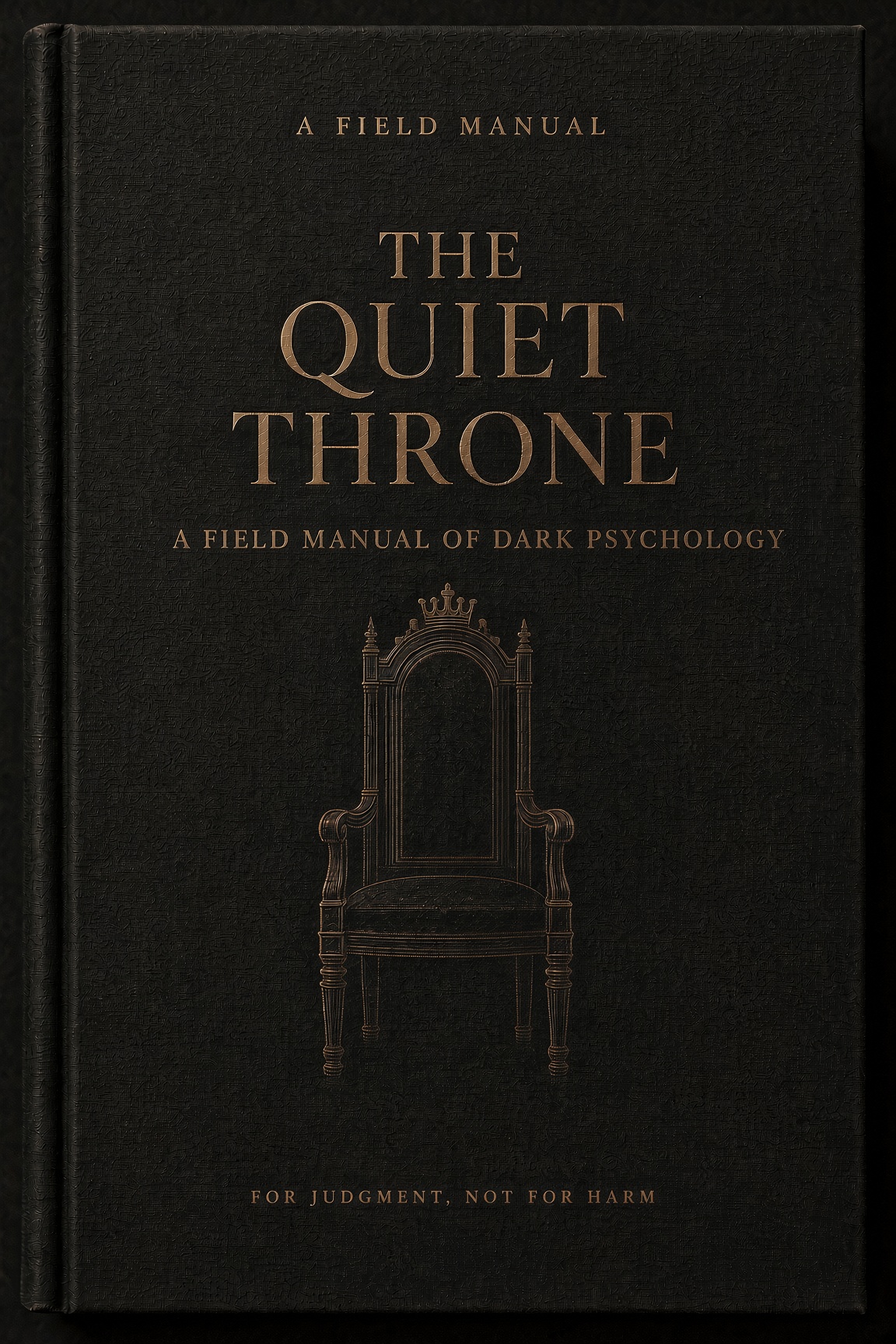
Front cover of The Quiet Throne. Black cloth, gold type, an empty throne.

Dark psychology

The Quiet Throne

Ever wanted to understand dark psychology?

A field manual of dark psychology

$12

13 chapters · about 2 and a half hours · paid on Stripe

Look inside

The problem is not that you are too kind. It is that the game is already being played, and nobody is going to explain the moves. This manual is how you see them.

For judgment, not for harm.

The problem

Seeing the game before you are inside it

Most people meet dark psychology as a rumor: tricks for cruel people. In a real room it is quieter. Who frames the question. Who is owed. Whose silence moves the decision. This book is how that works, and how to tell it apart from simple damage.

  1. See it

    The room is already keeping score. Before you speak, notice who is allocating attention and who is only performing.

  2. Name it

    Write the motive in private. Refuse the frame that was built to shrink you. Do not expose the person to prove you saw it.

  3. Stop it

    A move that humiliates, isolates, or frightens people is not a better tactic. It is damage, and damage recruits a quiet coalition.

What you will learn

How to see the move before you are inside it

  • Read the room

    See the scoreboard no one writes down: attention, rank, and the transfer that happens without a vote.

  • Find the motive

    Hear safety, status, belonging, or the wish not to be handled under the sentence you were asked to answer.

  • See status

    Notice who can interrupt, who restates an idea until it is theirs, and what a flinch gives away.

  • Refuse the frame

    The person who frames the question decides what counts as an answer. You learn how to name the box.

  • Price attention

    Know what not to say, so a room cannot spend your words against you later.

  • Know the shadow

    Favors, tells, rivalry, and the knives that stay sheathed. Spectacle is a bill, not a method.

What you'll leave with

A way to read the room with your eyes open

  • The manual

    Twelve laws and a prologue you can open again before a hard room, not a speech you hear once.

  • The scoreboard

    Who is looked at, whose idea changes owners, and what the silence is already saying.

  • The motive

    The argument under the stated one, so you stop answering a question that was built for someone else.

  • A limit

    How to see the move, and the point at which it becomes damage. For judgment, not for harm.

Why this matters to you

You are already in the game. You may not be able to see it.

If you only hear the stated argument, the room will keep using your attention and giving the decision to someone who saw the motive. You leave thinking you were clear. They leave holding the frame.

That costs you the next year of information. People stop bringing you the part they think you cannot stand. You start answering questions that were built to shrink you, and you call the result a discussion.

This is for you if you can feel a move and cannot yet name it. You do not need a louder personality. You need the scoreboard, the motive, and the point at which a tactic becomes damage.

Look inside

The prologue

Free to read. The laws come after.

Prologue

Before the Game

People who say they do not play games are usually losing with their eyes closed.

Every room in which something can be taken — a board, a shop floor, a campaign, a family business, a first week among people who already know the exits — is already keeping score. Who is interrupted. Whose idea is repeated by someone with more rank and only then becomes real. Who is asked to stay after. Who is explained to, and who is consulted. None of this is written down. All of it decides where the room will look when a choice has to be made.

Dark psychology is the name for influence the other person would not have chosen in full daylight. The crude forms are easy to name: flattery, fear, a manufactured urgency, a truth with the inconvenient half cut away. The quieter forms last longer, because they do not look like an attack. Framing, timing, status, the management of a face. This book is about those quieter forms, and about seeing the crude ones before you are standing inside them.

Continue from here

Written for the room, not the rumor

  • The watched

    You can feel the scoreboard move and you still leave the room explaining yourself.

  • The correct person

    You win the argument and stay a satellite, because someone else decides if your point is allowed to live.

  • The careful one

    You can feel a frame closing, and you want a way out that will not be quoted against you later.

See it before you are inside it.

$12 for the full field manual. Twelve laws of dark psychology. For judgment, not for harm.

Start reading